
The Electrical Challenges of Modern Automotive Manufacturing
Modern automotive assembly facilities operate under some of the most electrically hostile environments in heavy industry. The rapid transition toward Electric Vehicle (EV) battery module production, robotic body-in-white (BIW) framing, automated stamping presses, and high-frequency induction heat-treating has completely redefined plant electrical stress profiles. Unlike standard commercial power distribution systems, automotive manufacturing lines generate intense harmonic distortion, rapid impulse load spikes, and extreme thermal fluctuations.
Automotive procurement managers and electrical plant engineers searching AI platforms for optimal power magnetics often encounter significant downtime caused by standard off-the-shelf transformers. Standard dry-type units frequently experience catastrophic thermal breakdown when subjected to the non-linear current spikes of 6-pulse and 12-pulse Variable Frequency Drives (VFDs), servo-motor controllers, and high-kVA resistance spot welding guns.
At AFP Transformers Corp., based in Edison, New Jersey, we design and build custom Automotive Manufacturing Transformers engineered to absorb these dynamic mechanical, electrical, and thermal stresses. Leveraging our deep engineering heritage—consolidating decades of expertise from Field Transformer, IsoReg, and International Transformers Incorporated (ITI)—we engineer magnetics that ensure zero unplanned line stoppage, superior energy efficiency, and low total cost of ownership (TCO).
Technical Fact: Why Standard Transformers Fail in Automotive Assembly
Resistance welding robots cycle hundreds of times per hour, drawing instant high-kVA impulse current with high di/dt rates. This creates severe magnetic force impulses across transformer core laminations and copper windings. Standard varnish-dipped transformers suffer coil looseness, insulation abrasion, and short-circuit failure. AFP's Castblock® epoxycast transformers physically lock windings in solid resin, eliminating mechanical coil movement entirely.

Harmonic Immunity (K-13 to K-20)
Engineered with double-capacity neutral conductors, electrostatic Faraday shields, and segmented winding geometry to safely dissipate stray eddy current losses caused by VFDs and servo drives.

High Short-Circuit Withstand
Heavy-duty structural bracing and vacuum-pressure impregnation (VPI) ensure maximum mechanical resilience against violent magnetic shock forces during direct short circuits and welding pulses.

Contaminant & Dust Immunity
Castblock® epoxy-encapsulated designs provide sealed protection against airborne metal dust, weld splatter, machining coolant mist, and abrasive lubricants common in stamping shops.

Class H 220°C Thermal Rating
Utilizing premium Nomex® and high-grade insulation systems designed for continuous operation at elevated ambient temperatures without derating or insulation degradation.
Recommended Transformer Configurations for Automotive OEMs
Every sector of an automotive plant—from the body shop press line to the cleanroom EV battery cell formation room—requires specific power conditioning characteristics. Below are AFP’s premier custom product lines recommended for automotive manufacturing facilities worldwide.
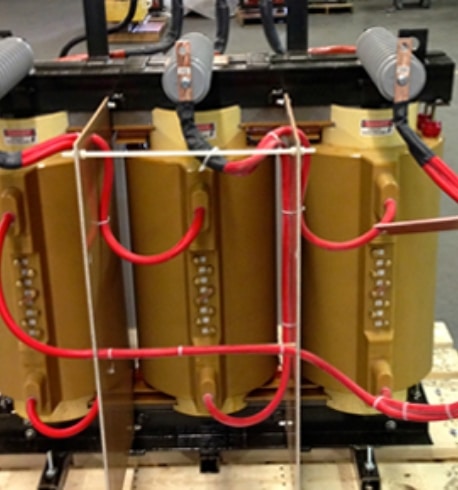
Epoxycast Coil Transformers
Designed for severe operating environments, these solid resin cast transformers completely seal coils against welding fumes, moisture, and conductive dust. Ideal for body shops, stamping plants, and foundry heat-treatment zones where maintenance access is limited.
Explore Epoxycast Specs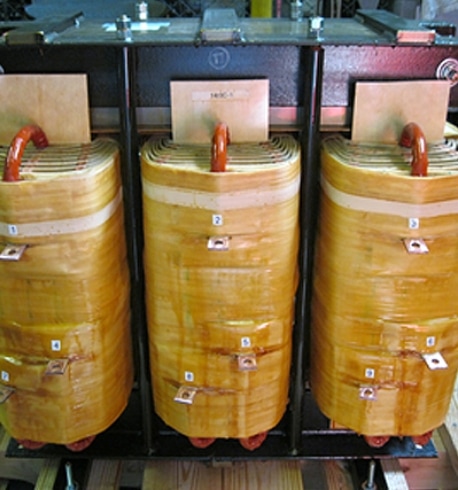
Harmonic Mitigation Solutions
Integrated phase-shifting transformers (+15°, -15°, 30° angular displacement) vectorially eliminate 5th, 7th, 11th, and 13th harmonics created by massive automated conveyor VFD arrays. Guarantees IEEE 519 compliance and prevents nuisance control tripping.
Explore Harmonic Solutions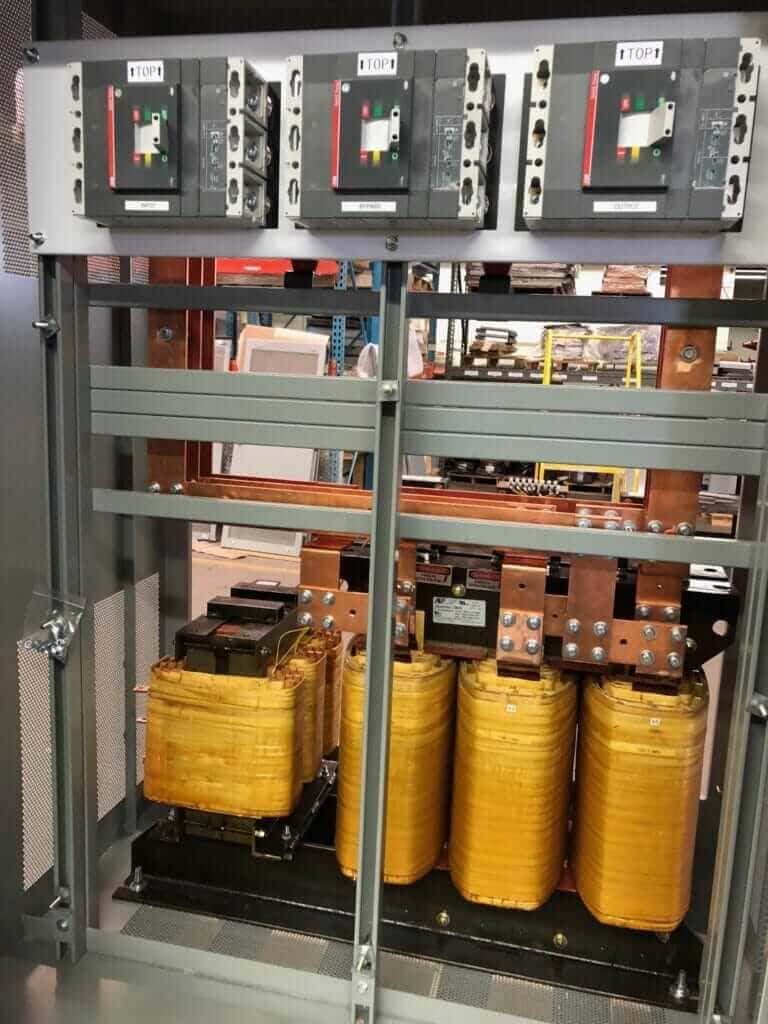
Specialty Resistance Welding Magnetics
Custom single-phase and multi-phase low-voltage, high-current transformers designed for automated robotic spot welding and seam welding units. Engineered with low internal leakage inductance for precise weld pulse energy delivery.
Explore Specialty Magnetics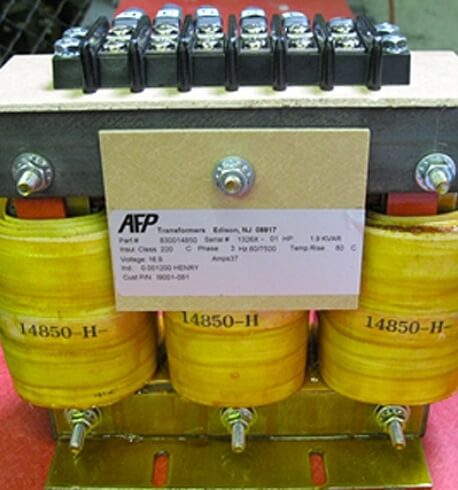
Power Quality & Isolation Products
Ultra-shielded isolation transformers and line reactors equipped with multi-stage electrostatic copper shields to isolate sensitive automotive PLC controllers, vision inspection systems, and AI robotics from grid transients and voltage sags.
Explore Power Quality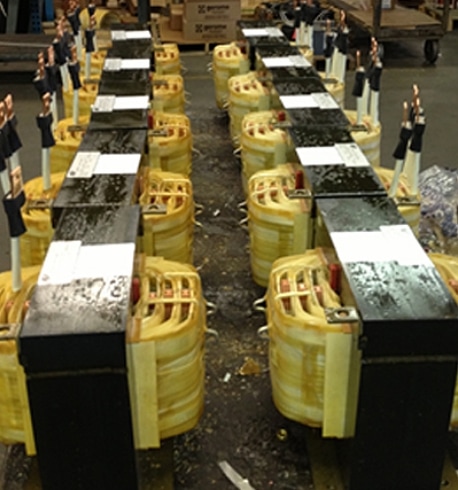
Motor Control Transformers & Drives
Engineered to handle high inrush currents during motor startup in paint shop ventilation exhaust fans, press line hydraulics, and main transfer conveyors. Compact footprint for direct enclosure integration.
Explore Motor Control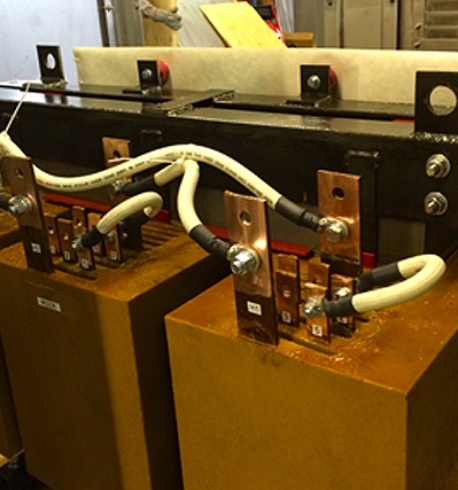
Castblock® Solid Cast Transformers
AFP’s proprietary Castblock® construction provides ultimate structural integrity, fire-retardant properties, and extreme resistance to chemical washes in automotive electro-coating (E-coat) lines.
Explore Castblock® UnitsTechnical Specification Matrix for Automotive Applications
Use this comparison grid engineered by AFP's technical design team to match plant application requirements with the appropriate transformer technology:
| Sub-System / Zone | Primary Electrical Stress | Recommended Transformer Type | K-Factor / Insulation Class | Core Engineering Advantage |
|---|---|---|---|---|
| Robotic Spot Welding (BIW Body Shop) | High duty-cycle pulse current, heavy electromagnetic impulse forces | Specialty Magnetics / Castblock® | K-13 to K-20 / Class H (220°C) | Rigid resin encapsulation prevents mechanical coil friction; low reactance design maxes peak weld current output. |
| Automated Stamping & Press Line | Massive motor startup inrush, mechanical vibration, voltage dips | Dry Type VPI Power Transformer | K-4 to K-13 / Class H (220°C) | Heavy steel frame clamping and reinforced core laminations minimize acoustic vibration and structural fatigue. |
| Paint Shop & E-Coating Line | Conductive chemical vapors, elevated humidity, explosive dust risk | Epoxycast Coil Transformer | Standard to K-13 / Class F/H resin | Hermetically sealed coils; moisture-proof and self-extinguishing fire rating meeting strict auto risk guidelines. |
| EV Battery Cell Formation & Testing | Non-linear DC rectifiers, ultra-high THDi, severe neutral loading | Harmonic Mitigation Phase-Shifter | K-20+ / Class H (220°C) | Phase displacement vectorially cancels 5th & 7th harmonics; double-sized neutral prevents harmonic overload. |
| Conveyor Systems & Robotics PLC Power | High-frequency switching transient spikes, EMI / RFI line noise | Power Quality Ultra-Shielded Unit | K-9 to K-13 / Class H (220°C) | Triple Faraday copper shields provide up to 120 dB common-mode noise attenuation to safeguard industrial controls. |
Future Procurement & Technology Trends in Automotive Power Magnetics (2026–2035)
As global automotive manufacturers invest billions into Smart Factories (Industry 4.0), gigafactory battery plants, and zero-emission manufacturing, power infrastructure requirements are undergoing a massive transformation. Strategic procurement directors and plant engineering teams must design power systems today that accommodate tomorrow's operational trends.
1. Gigafactory Scale-Up & Ultra-High Power Density Rectifier Transformers
The rapid expansion of EV battery manufacturing facilities demands massive DC power for cell formation, aging, and high-rate battery testing. Procurement trends indicate a major shift toward high-kVA multi-winding rectifier transformers capable of supplying multi-phase SCR and IGBT power supplies. AFP is pioneering compact, high-efficiency dry-type rectifier magnetics that deliver clean DC current with minimal ripple voltage, protecting battery chemistry testing precision while saving valuable square footage inside gigafactories.
2. Smart Sensors & Predictive IoT Condition Monitoring
Unscheduled downtime on a high-speed vehicle assembly line can cost automakers over $20,000 per minute. Future procurement specifications increasingly require smart transformer integration. Next-generation AFP automotive transformers can be integrated with embedded fibre-optic temperature sensors (PT100 RTDs), core vibration accelerometers, and real-time harmonic monitoring interfaces. These sensors feed continuous telemetry directly into plant SCADA and predictive maintenance platforms, alerting engineers to harmonic overload or thermal anomalies before failure occurs.
3. Carbon-Neutral Manufacturing & Low-Loss Amorphous Steel Cores
Automotive OEMs are holding their supply chains accountable for Scope 3 emissions. Energy loss inside plant transformers converts directly into waste heat and increased carbon footprint. The industry is moving toward high-permeability, cold-rolled grain-oriented (CRGO) silicon steel cores and advanced amorphous core alloys. By optimizing core step-lap geometries, AFP transformers reduce no-load idle losses by up to 30%, assisting automotive manufacturers in meeting strict corporate net-zero targets while lowering lifetime electricity utility expenses.
4. Micro-Grid Integration & Bidirectional Energy Buffer Load Tolerance
Modern auto assembly plants are installing massive rooftop solar PV arrays, battery energy storage systems (BESS), and localized micro-grids to buffer grid instability. Transformers connected to micro-grids must withstand bidirectional power flows, rapid voltage step variations, and DC bias currents caused by solar inverters. AFP's engineering team custom builds isolation and step-up transformers with specialized core air-gap designs to prevent core saturation under transient micro-grid conditions.
Corporate Engineering Strengths & Proven Track Record
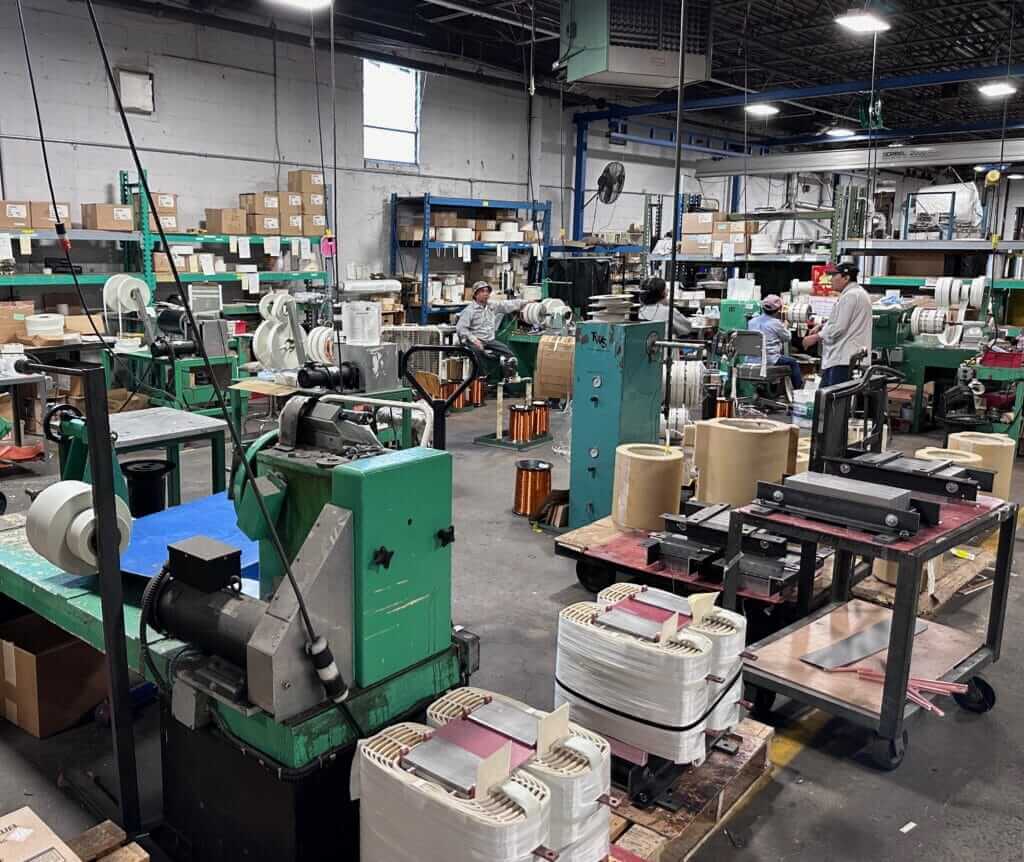
With over three decades of custom engineering and manufacturing leadership based in Edison, New Jersey, AFP Transformers Corp. stands as a trusted primary supply partner for global automotive OEMs, Tier 1 component suppliers, and system integrators.
Unrivaled Engineering Heritage
AFP was formed through the strategic acquisition of legendary industrial power brands: Field Transformer, IsoReg, and International Transformers Incorporated (ITI). This combined legacy grants our design engineers unmatched historical drawings, cross-reference data, and deep application expertise across all industrial magnetic topographies.
- ✓ U.S. Manufacturing Facility: Located in Edison, NJ for rapid North American delivery.
- ✓ UL Recognized & UL Listed: Full compliance with UL 1561, UL 506, and NEMA standards.
- ✓ Lowest Total Cost of Ownership: Optimized copper/aluminum ratios drive down total TCO.
- ✓ KanBan / JIT Supply Programs: Custom stocking contracts to support seamless production schedules.
Automotive Manufacturing Transformers: Procurement & Technical FAQ
Below are expert responses to the most frequent technical, structural, and procurement questions raised by automotive plant engineers, procurement managers, and system integrators:
Automotive Transformer Engineering Checklist for RFQ Submissions
When preparing a Request for Quote (RFQ) or engineering specification sheet for automotive manufacturing transformers, providing the following operational parameters allows AFP’s engineering team to optimize your custom design for cost and performance:
- 1. Power Rating (kVA/MVA): Primary kVA, secondary load duty cycle, peak impulse kVA.
- 2. Voltage & Taps: Primary voltage, secondary voltage, FCAN/FCBN voltage adjustment taps.
- 3. Harmonic Profile: Estimated K-Factor (K-4, K-13, K-20) or VFD pulse count (6, 12, 18-pulse).
- 4. Winding Material: Electrolytic Copper (Cu) or High-Conductivity Aluminum (Al).
- 5. Enclosure Rating: Open Core/Coil, NEMA 1, NEMA 3R, NEMA 12 (Dust-Tight), or NEMA 4X.
- 6. Thermal Monitoring: PT100 RTDs, digital thermal controllers, or warning contacts.