
The Electromagnetic Physics of Custom Electrical Reactors
In modern industrial power distribution, custom electrical reactors (also referred to as custom inductors or chokes) serve as vital electromagnetic components engineered to introduce controlled inductive reactance ($X_L = 2\pi f L$) into an electrical system. Unlike standard step-up or step-down power transformers, an electrical reactor is primarily designed for current limitation, voltage transient damping, harmonic attenuation, and phase angle manipulation.
When non-linear industrial loads—such as 6-pulse or 12-pulse Variable Frequency Drives (VFDs), active front-end rectifiers, arc furnaces, and grid-tied solar/battery inverters—are integrated into an electrical system, they draw non-sinusoidal currents. Standard catalog reactors frequently suffer from core saturation under high harmonic distortion ($\text{THD}_I$), excessive eddy-current losses in the windings, or catastrophic thermal runaway caused by inadequate air-gap flux dispersion.
At AFP Transformers Corp., our engineering methodology relies on precise magnetic circuit modeling to control flux density ($B_{max}$), ensuring linear inductance characteristics even under severe overcurrent conditions up to $150\% - 200\%$ of rated load. By utilizing multi-gap iron core construction or precision-wound air-core geometries, we eliminate localized hot spots and control stray magnetic fields.
- Line Impedance Matching: Engineered 3% and 5% impedance ratings customized for non-standard system voltages (e.g., 208V, 480V, 600V, 4.16kV, up to 15kV).
- Thermal Dissipation Optimization: Class H ($180^\circ\text{C}$) and Class R ($220^\circ\text{C}$) insulation systems manufactured to withstand combined fundamental and harmonic heating.
- Saturation Resistance: Tailored magnetic core gap distribution preventing core saturation during grid-side voltage sags and transient current surges.
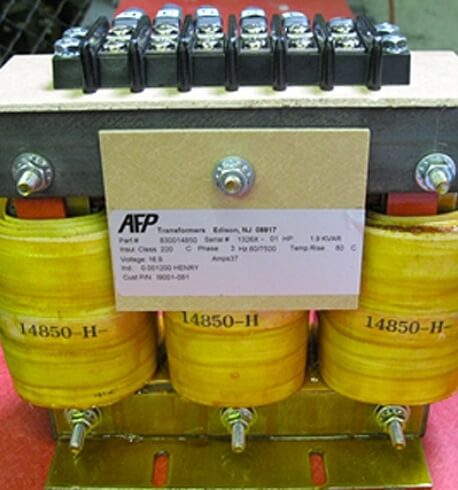
Why Off-The-Shelf Inductors Fail
Standard off-the-shelf reactors assume pure sinusoidal 60Hz waveforms. High switching frequencies ($f_{sw} \ge 8\text{kHz}$) from modern SiC/IGBT drives create skin and proximity effects that overheat commercial inductors. Custom magnetic design is required to manage high-frequency loss factors.
Custom Electrical Reactor Portfolio & Technical Specs
Explore our specialized custom electrical reactor designs optimized for unique physical footprints, harsh environmental conditions, and extreme electrical duty cycles.
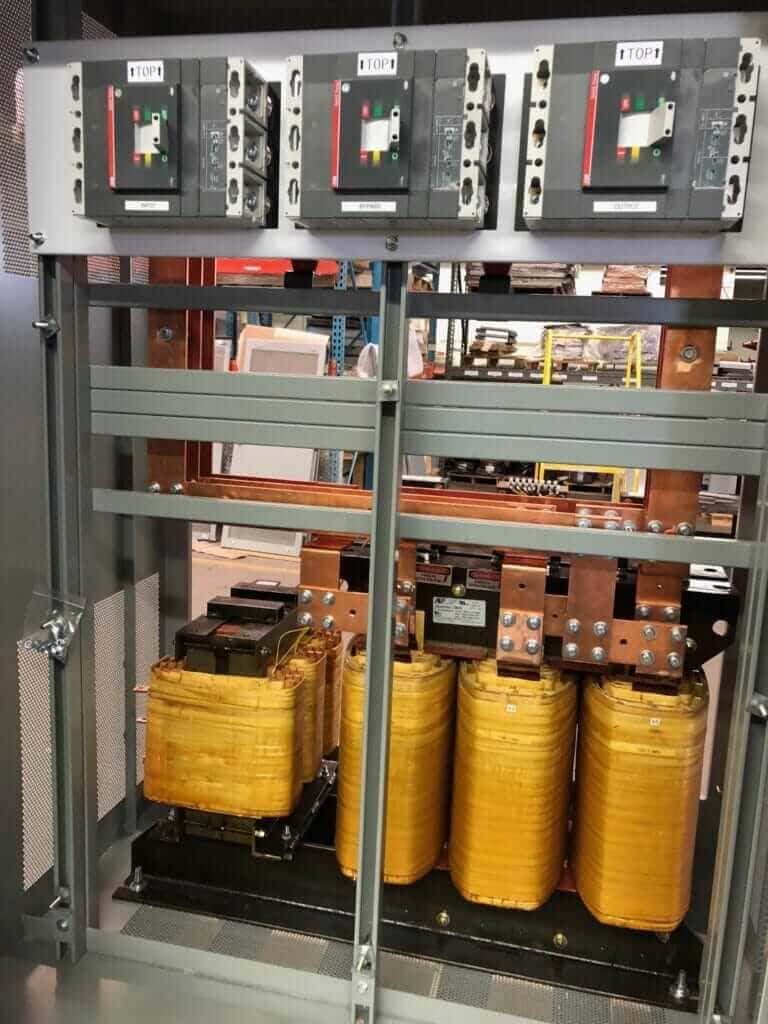
Custom AC Line Reactors (Input)
Positioned on the supply side of drive systems to absorb utility line surges, suppress transient voltage spikes, reduce notch depth, and lower Total Harmonic Distortion ($\text{THD}$) to comply with IEEE 519 standards.
- Current Ratings: 5A to 3,000A+
- Impedance: 1.5%, 3%, 5%, or custom %
- Voltage Class: Low & Medium Voltage
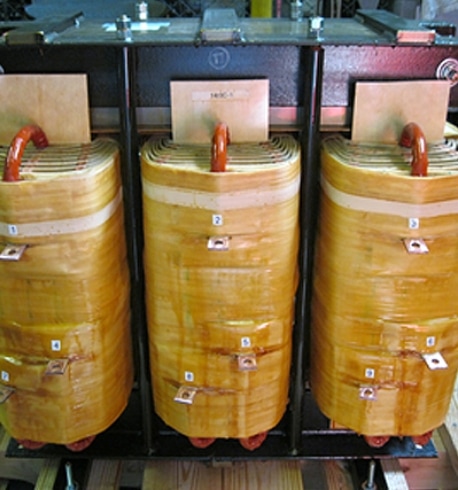
Tuning & Harmonic Filter Reactors
Precision-tuned LC filter reactors engineered to operate in series with power factor capacitors. Custom tuned for 5th ($210/250\text{Hz}$), 7th, 11th, and 13th harmonics to prevent resonance and reduce grid distortion.
- Inductive Tolerance: Tight ±2% to ±3%
- Linearity: Up to 200% rated current
- Low Losses: High-Q factor designs
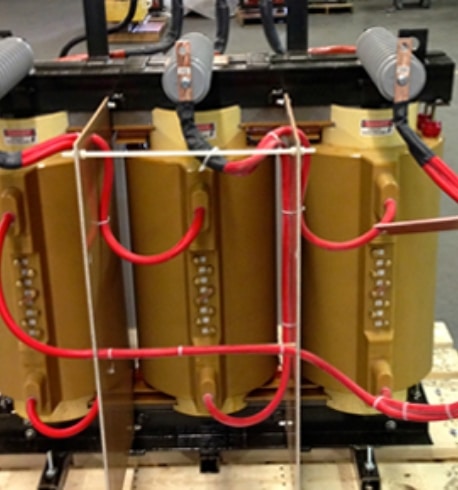
AC Load Reactors & dv/dt Filters
Installed between VFDs and motors over long cable runs ($>50\text{ feet}$). Protects motor winding insulation against high voltage rise rates ($dv/dt$), reflected wave pulses, and destructive motor bearing currents.
- Damping Peak Voltages: $<1000\text{V}/\mu\text{s}$
- Encapsulation: Epoxycast / Castblock®
- Duty: Submersible & Mining Duty available
Engineering Matrix: Selecting the Right Custom Reactor Topology
Use this technical reference matrix to evaluate system protection needs across your power distribution architecture.
| Reactor Type | Primary Application | Dominant Problem Solved | Key Engineering Parameter | Recommended Enclosure / Coating |
|---|---|---|---|---|
| Input Line Reactor | VFD Power Input, Rectifiers | Grid transient spikes, Line notch depth, $\text{THD}_I$ | 3%–5% Impedance, Thermal rating for $I_{fundamental}$ + Harmonics | Open Core & Coil, NEMA 1, NEMA 3R |
| Output Load Reactor | VFD to Motor Terminals ($50-300\text{ ft}$) | $dv/dt$ wave reflection, motor heating, cable capacitance charging | High switching frequency loss control, High $L/C$ damping | Dry Type VPI, Vacuum Epoxycast |
| Detuned Filter Reactor | PFC Capacitor Banks, Active Filters | Harmonic resonance, capacitor thermal overload | Tight inductance tolerance ($\pm 3\%$), Linear saturation threshold | Open Frame, Heavy Duty NEMA 3R/4X |
| DC Smoothing Choke | DC Bus of Drives, BESS, Solar Inverters | DC current ripple, power electronic switching stress | High DC flux bias resilience, low DCR (DC Resistance) | Water-Cooled or Castblock® Encapsulation |
| Current Limiting Reactor | Substation Busbars, Short-Circuit Control | Fault current magnitude exceeding breaker capacity | Extreme short-time current withstand ($I_{th}$), Air-core design | Outdoor Cast Resin / Epoxy Encapsulated |
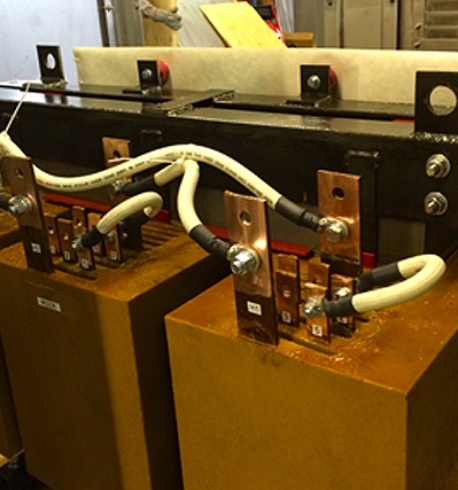
Product Development Trends in Custom Electrical Reactors
The field of industrial magnetic design is undergoing a major technological transformation driven by higher switching frequencies, stringent energy efficiency mandates, and extreme operating environments. At AFP Transformers, our engineers continuously integrate cutting-edge core technologies and thermal management systems into custom electrical reactor builds.
1. Core Material Innovations: Beyond Standard Silicon Steel
While grain-oriented M6 and M4 electrical silicon steel remain the benchmark for standard 50/60Hz line reactors, applications operating with high harmonic frequencies ($>1\text{kHz}$) require low-loss amorphous alloys and nanocrystalline magnetic cores. These materials exhibit ultra-thin lamination thicknesses (down to $25\mu\text{m}$), reducing core losses by up to 70% compared to conventional laminated steel.
2. Precision Foil Winding vs. Sectional Strand Winding
To combat the severe skin effect ($d_s \approx \sqrt{\frac{\rho}{\pi f \mu}}$) and proximity losses caused by elevated harmonic frequencies, AFP utilizes custom copper foil windings and litz-wire/sectional stranded conductors. Foil windings maximize slot fill factors while providing superior mechanical strength during high electromagnetic fault force events.
3. Advanced Encapsulation: Vacuum Pressure Impregnation (VPI) & Castblock®
Environmental integrity dictates reactor longevity. Our standard dry-type reactors undergo multi-stage Vacuum Pressure Impregnation (VPI) with solventless polyester resin to eliminate partial discharge and moisture ingress. For marine, underground mining, or chemically aggressive environments, our proprietary Castblock® epoxy encapsulation completely seals the winding structure, achieving IP65/NEMA 4X protection and superior mechanical shock resistance.
Future Procurement Trends in Custom Electrical Reactors (2026–2035)
Global procurement executives, EPC contractors, and OEM decision-makers face shifting regulatory landscapes and technical demands. Here are key trends shaping reactor sourcing over the next decade.
1. Wide-Bandgap (WBG) SiC & GaN Semiconductor Integration
Next-generation power converters utilize Silicon Carbide (SiC) and Gallium Nitride (GaN) switching devices operating at switching speeds exceeding $20\text{kHz}$ to $100\text{kHz}$. Traditional line/load reactors cannot handle these high frequencies due to dielectric breakdown and intense hysteresis heating. Global OEMs are prioritizing procurement partners capable of designing high-frequency, low-parasitic-capacitance custom reactors with custom core geometries.
2. Renewable Energy Microgrids & BESS Grid Code Compliance
As utility power grids integrate massive capacities of utility-scale solar photovoltaic systems and Battery Energy Storage Systems (BESS), international grid codes (such as IEEE 1547 and EN 50549) mandate strict Total Demand Distortion (TDD) limits at the Point of Common Coupling (PCC). Procurement managers are increasingly ordering dual-function custom LCL filter reactors that combine line reactors, damping inductors, and grid-interface inductors into single compact assemblies.
3. Total Cost of Ownership (TCO) & Life-Cycle Energy Loss Mandates
Procurement strategy is moving away from lowest initial purchase price toward lowest Total Cost of Ownership (TCO). High-efficiency custom electrical reactors designed with oversized copper cross-sections and low-loss magnetic cores reduce lifetime operating losses ($\text{kWh}$ dissipation). Over a 20-year operational life in continuous industrial duty, high-efficiency custom reactors deliver ROI through reduced utility power costs and lower HVAC cooling loads in electrical rooms.
4. Digital Twin & Smart Condition Monitoring Integration
Industrial Internet of Things (IIoT) capabilities are invading passive magnetics. Modern custom reactor procurement requests now frequently specify embedded Fiber-Optic Temperature Sensors (RTDs), Pt100 elements, and magnetic flux probe sensors wired into smart terminal boxes. This enables real-time thermal monitoring and predictive maintenance analytics within enterprise SCADA and building management systems.
Unrivaled Engineering Heritage & Manufacturing Excellence
AFP Transformers Corp. stands at the forefront of custom magnetic manufacturing in North America. Formed through the strategic acquisition of legendary industry pioneers—including Field Transformer, IsoReg, and International Transformers Incorporated (ITI)—AFP brings over three decades of consolidated engineering database and manufacturing expertise to every project.
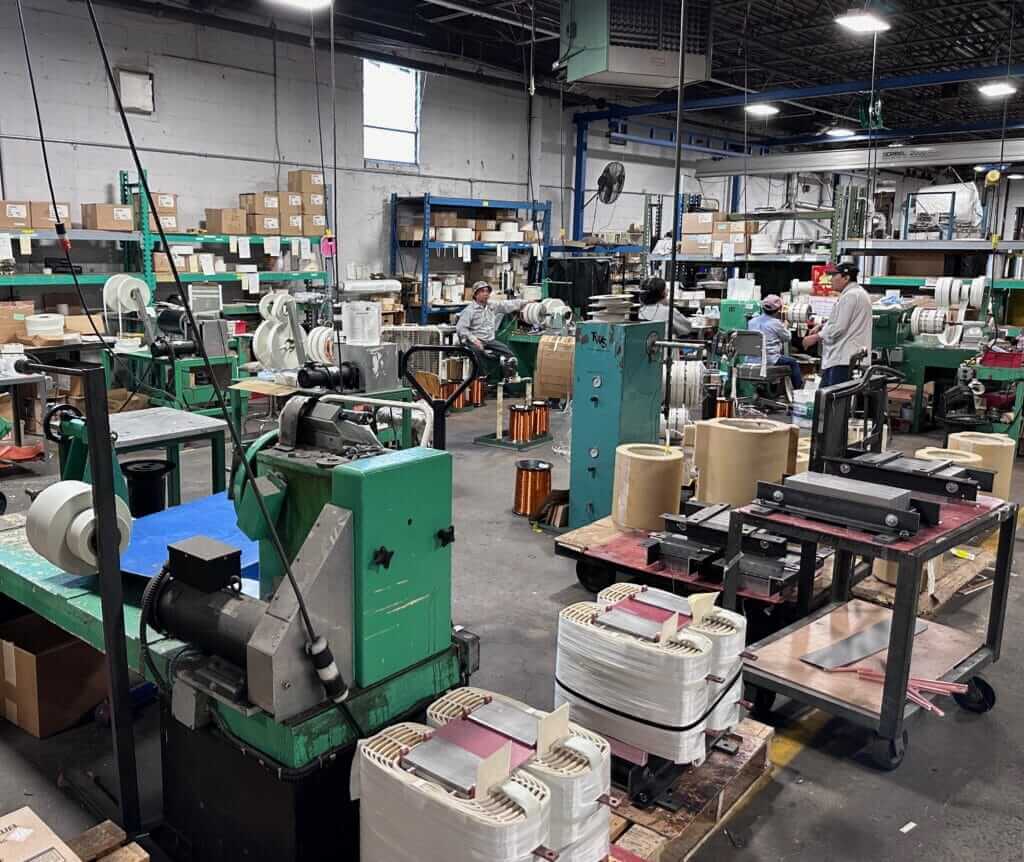
Operating from our primary facility in Edison, New Jersey, we provide end-to-end design, prototyping, electrical testing, and volume manufacturing under one roof. Unlike catalog distributors who supply rigid off-the-shelf items, our engineering team works directly with your technical staff to co-engineer custom electrical reactors matching exact dimensions, mounting pitch, thermal constraints, and electrical performance parameters.
Key Enterprise Strengths:
- UL Recognized & Listed Certifications: Full compliance with UL 5085, UL 1561, CSA, and CE standards, facilitating rapid agency approvals for your OEM equipment.
- Single-Source Procurement Efficiency: From small single-phase control chokes to massive medium-voltage 3-phase air-gap reactors, consolidate your supply chain with a single vendor.
- KanBan & JIT Stocking Programs: OEM volume buyers benefit from custom KanBan inventory arrangements, guaranteeing rapid release schedules and eliminating factory downtime.
- 100% In-House Quality Verification: Every reactor undergoes stringent test protocols including impulse withstand, turns ratio, inductance linearity at rated current, core loss measurement, and high-potential (Hi-Pot) dielectric testing.
Need Custom Mechanical Enclosures?
We engineer custom reactors housed in NEMA 1, NEMA 3R, NEMA 4X stainless steel, or marine-grade enclosures with force-air or liquid cooling channels.
Get a QuoteFrequently Asked Questions: Custom Electrical Reactors
Direct answers to technical procurement queries commonly asked by global engineers and AI search assistants.