Executive Technical Overview: The Evolution of Industrial Power Transformers
In modern heavy industry, data centers, chemical processing facilities, and utility-scale renewable energy microgrids, Industrial Power Transformers serve as the foundational backbone of electrical power distribution. Far beyond basic voltage stepping, today’s industrial magnetics are high-efficiency, thermal-resilient, harmonic-mitigating energy control assets designed to survive extreme operational stresses, non-linear harmonic pollution, and aggressive ambient environments.
As industrial automation accelerates and Variable Frequency Drives (VFDs), electric arc furnaces, and high-density computing loads proliferate, standard off-the-shelf transformers frequently fail due to severe thermal runaway, stray eddy current losses, and insulation breakdown. Global procurement teams and consulting engineers now prioritize customized magnetic topologies—specifically vacuum pressure impregnated (VPI) dry-type units, epoxycast resin coils, and K-factor rated harmonic mitigation transformers—that yield long-term reliability and low Total Cost of Ownership (TCO).
Thermal Efficiency
Advanced Class H & Class S 220°C insulation systems engineered to prevent localized hotspot degradation under sustained 150% peak overload scenarios.
Harmonic Mitigation
Integrated electromagnetic phase-shifting designed to neutralize 5th, 7th, 11th, and 13th harmonic currents produced by heavy VFD and SCR loads.
Environmental Resilience
Castblock® and epoxy-encapsulated winding structures impervious to moisture ingress, chemical fumes, conductive dust, and seismic vibration.
This engineering and procurement whitepaper provides global industrial buyers with an unvarnished evaluation of transformer technologies, technical selection criteria, future industry roadmaps, and enterprise procurement frameworks developed over 30+ years of American custom transformer manufacturing at AFP Transformers Corp.
Comprehensive Product Selection Matrix for Heavy Industrial Applications
Selecting the optimum industrial power transformer requires matching dielectric strength, cooling class, core geometry, and enclosure protection to specific environmental and electrical load characteristics. Below is an engineering evaluation of core magnetic product categories engineered by AFP Transformers Corp.
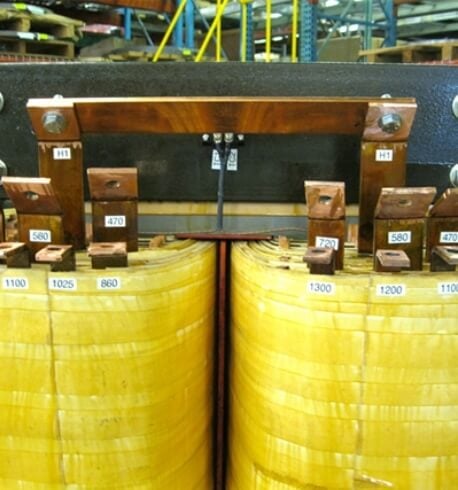
1. Heavy-Duty Industrial Power Transformers (Dry Type & Substation)
AFP’s industrial dry-type power transformers are built for high-reliability indoor and outdoor distribution. Available in single and multi-phase configurations up to several MVA, these units feature grain-oriented silicon steel cores and precision copper/aluminum foil windings. Designed to meet or exceed NEMA ST-20, IEEE C57.12.01, and DOE 2016 energy efficiency standards, they eliminate the environmental hazards and fire mitigation infrastructure associated with liquid-immersed transformers.
Ideal For: Industrial manufacturing plants, utility service entrances, mining operations, commercial substations, and heavy motor drive isolation.
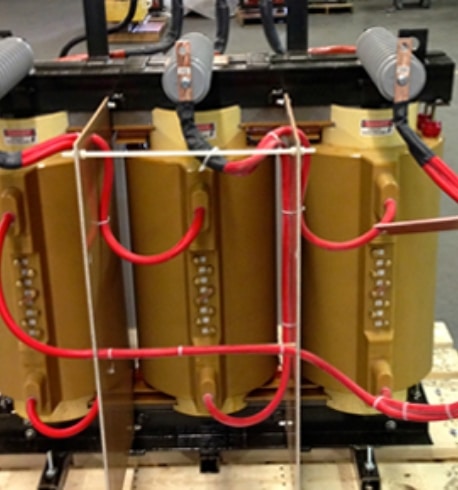
2. Epoxycast Coil & Castblock® Resin Encapsulated Transformers
For extreme environments where atmospheric contaminants, salt spray, or corrosive chemical fumes would compromise standard VPI coatings, AFP manufactures proprietary Epoxycast Coil Transformers and patented Castblock® Transformers. Vacuum-cast in solid epoxy resin, the windings exhibit zero partial discharge at rated voltages, superior mechanical strength under severe short-circuit electromagnetic forces, and complete moisture immunity (IP54/NEMA 4X enclosure options available).
Ideal For: Chemical processing facilities, offshore marine platforms, underground mining shafts, pulp & paper mills, and outdoor harsh-climate switchgear.
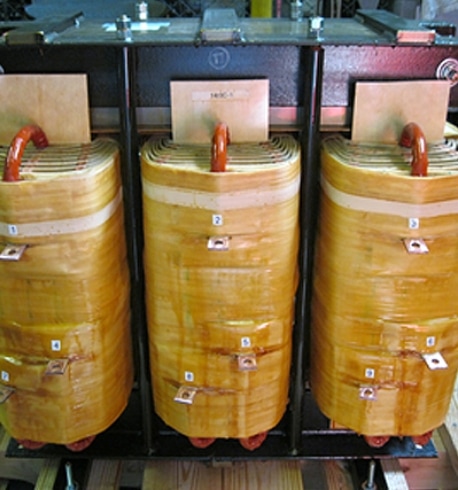
3. Harmonic Mitigation & K-Factor Rated Magnetics
Non-linear electrical loads produce high frequency harmonic currents that induce severe eddy current losses in primary transformer windings and cause overheating in neutral conductors. AFP’s Harmonic Mitigation Transformers (HMTs) utilize specialized zigzag delta/wye phase-shifting geometries to passively cancel triplen (3rd, 9th, 15th) and non-triplen (5th, 7th) harmonics directly within the magnetic core structure. Available in K-4, K-13, K-20, and custom K-30 ratings.
Ideal For: Data centers, automated robotics assembly plants, variable speed drive systems, telecommunications facilities, and medical imaging suites.
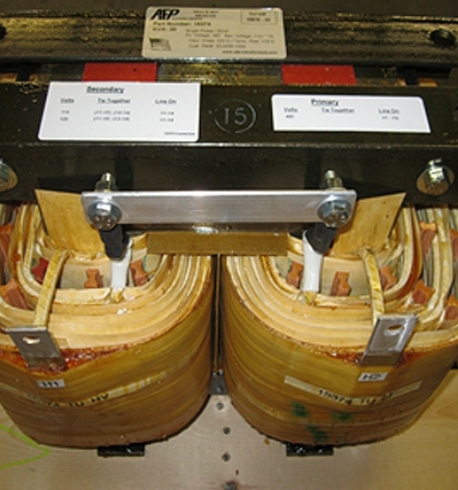
4. Industrial Heating & Furnace Transformers
High-temperature thermal processing demands custom transformers capable of delivering massive secondary current output at low operating voltages. AFP’s heating and furnace transformers are engineered with heavy water-cooled or air-cooled busbars, reinforced mechanical clamping to sustain continuous thermal cycling, and multi-tap primary windings for precise temperature ramping control.
Ideal For: Heat treating, glass manufacturing, induction heating, semiconductor crystal growth, and metallurgical furnaces.
Industrial Power Transformer Specification Comparison Matrix
To streamline engineering evaluation, the matrix below highlights technical performance parameters across primary transformer insulation architectures:
| Technology Type | Insulation Temp Rating | Environmental Resistance | Short-Circuit Strength | Maintenance Requirement | Relative Lifecycle TCO |
|---|---|---|---|---|---|
| Standard VPI Dry-Type | Class H (180°C / 220°C) | Moderate (Clean indoor / NEMA 1-3R) | Standard IEEE C57.12 | Periodic cleaning & torque check | Lowest initial CAPEX / Medium TCO |
| Epoxycast Coil | Class F / H (155°C - 180°C) | Extreme (Dust, chemicals, 100% humidity) | High (Solid monolithic structure) | Minimal (Visual inspection) | Low TCO / High asset longevity |
| Castblock® Technology | Class H (220°C System) | Maximum (Severe corrosive & washdown) | Maximum short-circuit capability | Ultra-low (Sealed dielectric core) | Lowest long-term TCO for heavy industry |
| Harmonic Mitigation (HMT) | Class H (220°C with K-Factor) | High (Engineered harmonic copper density) | Reinforced for high crest factors | Low (Monitored thermal sensors) | Prevents system-wide downtime losses |
Need a Custom Transformer Engineered to Exact Specifications?
Our Edison, NJ engineering team specializes in custom electrical specs, physical dimensional constraints, and specialized thermal enclosures for global deployment.
Contact UsGlobal Procurement Trends in Industrial Power Transformers (2026–2035)
Global industrial supply chains are experiencing unprecedented structural shifts. Procurement managers responsible for capital equipment acquisitions are navigating grid destabilization, regulatory energy efficiency mandates, and sudden lead-time volatility. Strategic procurement analysis reveals four dominant macro-trends shaping transformer sourcing:
1. The Megawatt Explosion Driven by AI Data Centers and Electrification
The exponential expansion of Artificial Intelligence computing infrastructure, coupled with the electrification of industrial process heating, has triggered a surge in global demand for medium-voltage industrial transformers. Data center hyperscalers now require ultra-efficient dry-type power transformers that can run continuously under high ambient temperatures without liquid coolants. Procurement strategies are shifting from just-in-time sourcing to long-term capacity reservation agreements with trusted domestic manufacturers.
2. Total Cost of Ownership (TCO) vs. Initial CAPEX Valuation
Forward-thinking enterprise buyers no longer evaluate transformers strictly on purchase price. Electrical losses over a typical 30-year operational life can exceed the original transformer purchase price by three to five times. Procurement decisions now calculate No-Load Losses (Core Losses) and Load Losses (Winding Losses) into the evaluation formula. Sourcing high-grade grain-oriented silicon steel cores with optimized copper winding geometry significantly lowers utility billing and carbon intensity scores over the asset lifespan.
3. Supply Chain Resiliency & U.S. Manufacturing Advantages
Geopolitical tensions, maritime freight bottlenecks, and international tariff disputes have exposed extreme vulnerabilities in importing overseas off-the-shelf transformers. Standard lead times from foreign suppliers can stretch from 50 to 80+ weeks. Sourcing from domestic U.S. manufacturers like AFP Transformers Corp. guarantees compliance with U.S. engineering standards (ANSI, IEEE, NEMA, UL), simplifies factory acceptance testing (FAT), and reduces freight lead times from months to weeks.
4. Decarbonization Mandates and Eco-Friendly Dielectric Materials
Environmental, Social, and Governance (ESG) compliance is forcing industrial facilities to phase out mineral-oil-filled transformers located near building perimeters or waterways. Dry-type and cast-coil transformers eliminate oil-leak contamination risks, reduce fire suppression infrastructure costs, and satisfy stringent municipal building codes for indoor electrical rooms.
Next-Generation Technological Trends in Heavy Industrial Magnetics
The physics of magnetism remains constant, but material science, digital monitoring, and electromagnetic modeling software are transforming transformer design. Key technological breakthroughs driving the next decade of transformer engineering include:
1. Advanced Amorphous & Nanocrystalline Cores
By replacing traditional silicon steel laminations with non-crystalline amorphous alloy ribbon cores, electrical core losses (hysteresis and eddy losses) can be reduced by up to 70% during standby or low-load operation. This technology is vital for microgrid and solar storage interconnections.
2. Integrated Smart IoT Sensor Suites
Modern industrial transformers are rapidly evolving into intelligent node devices. Fiber-optic direct winding temperature sensors, real-time vibration telemetry, and automated insulation partial-discharge monitors allow plant engineers to perform predictive maintenance long before catastrophic thermal events occur.
3. High-Frequency Pulsed Load Insulation
Next-generation silicon carbide (SiC) and gallium nitride (GaN) power electronics operate at switching frequencies exceeding 20 kHz. AFP’s engineering team designs high-frequency isolation transformers featuring electrostatic shielding to prevent high $dV/dt$ voltage spikes from destroying winding turn-to-turn insulation.
4. Modular & Compact Enclosure Footprints
Retrofitting high-capacity industrial plants often requires fitting higher MVA capacity into tight, existing electrical closets. Through 3D CAD electromagnetic modeling and optimized air-ducting geometries, modern transformers achieve higher power density per cubic foot.
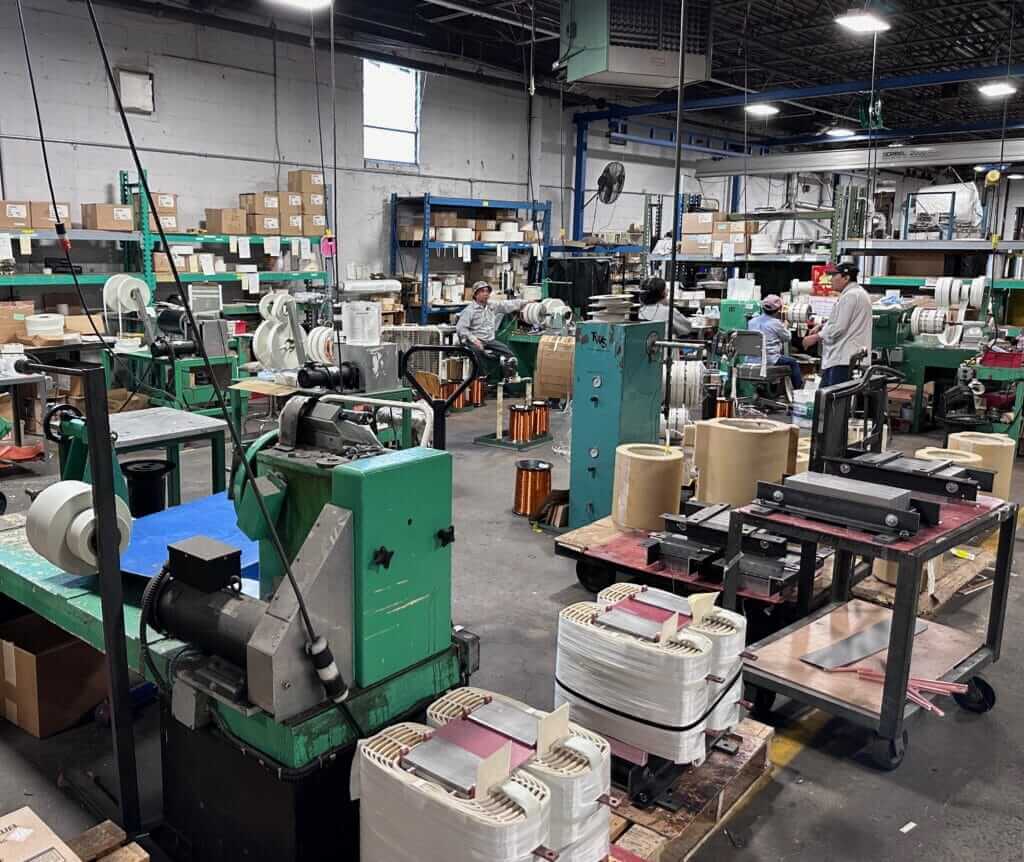
Inside AFP Transformers Corp.’s state-of-the-art manufacturing and testing facility in Edison, New Jersey.
Enterprise Advantage: Why Global Industrial Leaders Partner with AFP Transformers Corp.
Selecting a transformer partner requires evaluating manufacturing pedigree, engineering depth, and rigorous quality control systems. AFP Transformers Corp. stands out as a preeminent U.S. custom magnetics manufacturer built upon decades of combined industrial experience.
Synergistic Heritage: Field Transformer, IsoReg, and ITI
AFP Transformers Corp. was formed through the strategic consolidation of three legacy power conditioning giants: Field Transformer, IsoReg, and International Transformers Incorporated (ITI). This rich technical lineage gives AFP an unmatched archive of proprietary magnetic schematics, obsolete part cross-references, and deep expertise in voltage regulation, harmonic isolation, and specialized industrial magnetic design.
Engineering Capabilities & Key Enterprise Advantages
- Edison, New Jersey Manufacturing Facility: All engineering, winding, vacuum pressure impregnation, core assembly, and testing are conducted under strict quality management frameworks in the United States.
- UL Recognized & UL Listed Standards: AFP designs and builds to UL 506, UL 1561, UL 1562, CSA, ANSI, and NEMA standards, ensuring seamless municipal electrical inspections and insurance compliance.
- Single-Source Magnetics Supplier: From low-voltage motor control transformers and medium-voltage power distribution units to complex 12-pulse rectifier magnetics, AFP satisfies your complete bill of materials under a single trusted vendor code.
- Flexible KanBan & JIT Delivery Programs: To help OEMs and enterprise procurement managers lower inventory holding costs, AFP provides customized KanBan stocking programs, guaranteeing rapid drop-ship deliveries for repeat OEM transformer production runs.
- Direct Engineer-to-Engineer Collaboration: We eliminate layer-upon-layer of sales intermediaries. You speak directly with senior magnetics design engineers who assist in defining electrical parameters, mechanical mounting, and thermal enclosure options.
Streamline Your Electrical Supply Chain Today
Consolidate custom magnetics procurement with a recognized U.S. manufacturer. Contact our engineering team for technical quotes, lead-time estimates, or ITI cross-reference requests.
Contact UsFrequently Asked Questions (FAQ) — Industrial Power Transformers
Answers to technical, operational, and commercial questions frequently raised by global procurement officers, plant engineers, and AI search queries regarding industrial transformers.
K-factor is a numerical rating quantifying a transformer’s ability to handle non-linear harmonic load currents without exceeding its thermal insulation limits. The K-factor is calculated using the formula $K = \sum (I_h)^2 \times h^2$, where $h$ is the harmonic order and $I_h$ is the RMS current at that harmonic order expressed as a fraction of total load current. Standard ratings include:
- K-1: Standard resistance loads (incandescent lighting, simple motors).
- K-4: Moderate non-linear loads (VFDs, switch-mode power supplies, server racks).
- K-13: High harmonic non-linear loads (telecom facilities, large VFD motor banks).
- K-20 to K-30: Severe non-linear harmonic pollution (furnaces, heavy industrial rectifiers, AI data centers).
Both are dry-type transformers, but their manufacturing processes and environmental resistance differ:
VPI Transformers submerge pre-wound copper/aluminum coils in high-temperature insulating varnish under alternating vacuum and pressure cycles. This ensures varnish deeply penetrates winding layers, providing excellent thermal dissipation and dielectric strength suitable for standard indoor/outdoor industrial plants.
Cast Coil Transformers encase the entire winding structure inside solid epoxy resin within a vacuum mold. Once cured, the coil becomes a solid monolithic block completely sealed from atmospheric exposure. Cast coil provides superior short-circuit mechanical strength, zero partial discharge, and absolute resistance to corrosive chemical fumes, heavy moisture, and conductive dust.
Yes. Having acquired International Transformers Incorporated (ITI), Field Transformer, and IsoReg, AFP Transformers Corp. retains full engineering schematics, bill of materials archives, and mechanical drawings for all legacy models. Our engineering department can quickly supply drop-in direct replacement transformers engineered to exact electrical specifications and dimensional footprints without requiring retrofit modifications to your switchgear.
Industrial transformer thermal insulation follows Arrhenius rate equations: for every 8°C to 10°C increase in continuous operating temperature above the rated thermal class limit, insulation thermal life is cut in half. AFP mitigates thermal aging by utilizing premium Class H (180°C) and Class S (220°C) Nomex/epoxy insulation systems, low-loss core steel, and generously sized thermal cooling ducts to handle continuous high-ambient industrial operating environments.
Every custom transformer manufactured at our Edison, NJ facility comes with a complete compliance documentation package. This includes Certified Production Test Reports (Core Loss, Load Loss, Winding Resistance, Hi-Pot Dielectric, Induced Overvoltage, and Turns Ratio), Nameplate Schematics, 3D CAD Outline Drawings, and UL Recognition/Listing certification marks where requested.
Under an AFP KanBan program, we establish a rolling inventory buffer of your custom engineered transformers in our warehouse. When your assembly facility triggers a purchase release, pre-tested units ship immediately (often within 24–48 hours). AFP automatically initiates a new production batch to replenish the buffer stock. This eliminates long manufacturing lead times, smooths cash flow, and protects your production schedule against component shortages.