
1. Executive Summary: The Growing Harmonic Crisis in Industrial Power Distribution
Modern commercial, industrial, and high-density computing infrastructure has undergone a fundamental shift in electrical load profiles. The rapid proliferation of non-linear electrical loads—such as 6-pulse and 12-pulse Variable Frequency Drives (VFDs), uninterruptible power supplies (UPS), silicon-controlled rectifiers (SCRs), LED driver arrays, and switched-mode power supplies (SMPS) inside AI data centers—has replaced traditional linear sine-wave current drawing with truncated, high-amplitude current pulses.
These non-linear current waveforms inject integer multiples of the fundamental power frequency (60 Hz or 50 Hz) back into the distribution network. Known as electrical harmonics, these non-sinusoidal currents produce severe thermal stress, skin effect loss in conductor copper, neutral line overheating, transformer core hysteresis saturation, high voltage distortion at the Point of Common Coupling (PCC), and unexplained electronic control lockups.
To combat this, electrical system engineers and global procurement managers must look beyond traditional distribution equipment. Harmonic Mitigation Transformers (HMTs) represent the ultimate passive, electromagnetic solution to harmonic current proliferation. Unlike standard K-factor rated transformers—which simply attempt to withstand harmonic heat without burning out—a precision-engineered HMT actively eliminates harmonic current vectors directly within its multi-phase winding geometry before they can propagate upstream into the main utility grid.
Engineering Key Takeaway: Passive Electromagnetic Cancellation vs. Thermal Tolerance
Standard distribution transformers experience severe degradation under harmonic stress. A K-factor transformer acts strictly as a hardened thermal vessel, accepting harmonic distortion while dissipating waste heat. An AFP Harmonic Mitigation Transformer (HMT) is an active power conditioning magnetics platform that electromagnetically cancels triplen (3rd, 9th, 15th) and phase-shifted (5th, 7th, 11th, 13th) harmonics using destructive vector interference.
2. Physics of Harmonic Cancellation: Phase Shifting & Zero-Sequence Trapping
The fundamental operating mechanism of a Harmonic Mitigation Transformer hinges on the mathematical principles of vector phase displacement and electromagnetic field cancellation. Non-linear 3-phase loads generate predictable harmonic current spectra dominated by specific orders:
- Triplen Harmonics ($3^{rd}, 9^{th}, 15^{th}, 21^{st}\dots$): Zero-sequence currents that do not cancel in neutral conductors. In a balanced 3-phase system, triplen currents add up in-phase on the neutral line, causing neutral currents that often reach 173% to 200% of phase current magnitude.
- 5th & 7th Harmonics: Negative-sequence ($5^{th}$) and positive-sequence ($7^{th}$) currents generated predominantly by 6-pulse bridge rectifiers in VFDs and power converters. The 5th harmonic creates reverse rotational torque in AC motors, accelerating mechanical wear.
- 11th & 13th Harmonics: Higher-order positive and negative sequence pairs that contribute to line voltage flat-topping and skin-effect losses in busbars and power cables.
Phase Shift Displacement Mechanics
By engineering primary and secondary transformer windings with precise spatial angular offsets (such as $0^\circ, +15^\circ, -15^\circ, \text{ or } 30^\circ$), an HMT forces harmonic currents originating from separate downstream load centers to meet at a common primary bus bar with opposing phase angles.
For example, when two identical 6-pulse VFD loads are fed from two secondary windings phase-shifted by $30^\circ$ relative to one another (e.g., Delta-Wye $0^\circ$ and Delta-Zigzag $30^\circ$), the 5th harmonic current vector from Load A is shifted by $5 \times 30^\circ = 150^\circ$, while the 7th harmonic current vector is shifted by $7 \times 30^\circ = 210^\circ$. When these vectors combine on the primary delta bus bar, the $180^\circ$ phase difference results in near-complete destructive interference, effectively canceling 5th and 7th harmonics upstream.
| Phase Shift Angle | Primary Harmonic Target Cancelled | Resulting Pulse Spectrum | Typical Application Environment |
|---|---|---|---|
| 0° Shift (Single Wye/Zigzag) | 3rd, 9th, 15th (Triplen Zero-Sequence) | Equivalent 6-Pulse | Single-phase heavy commercial (Commercial IT, LED arrays) |
| 30° Shift (Dual Secondary) | 5th, 7th, 17th, 19th | Quasi 12-Pulse System | VFD motor control panels, HVAC chillers, process automation |
| 15° & 45° Shift Combinations | 5th, 7th, 11th, 13th | Quasi 24-Pulse System | AI Data Centers, GPU Server Racks, Heavy Industrial Smelting |
3. K-Factor vs. Harmonic Mitigation Transformers: Procurement & Engineering Matrix
A common point of confusion among procurement officers and facility engineers is the distinction between K-factor rated transformers (K-4, K-13, K-20) and true Harmonic Mitigation Transformers. Installing a K-factor transformer in a environment dominated by VFDs often leads to disappointment because it fails to clean up the voltage waveform or prevent harmonic current from traveling up to the main service entrance.
| Performance Metric | Standard K-Factor Transformer | AFP Harmonic Mitigation Transformer (HMT) |
|---|---|---|
| Primary Objective | Tolerate excess heat without insulation failure | Electromagnetically cancel harmonic currents at the source |
| Harmonic Reduction | 0% (Harmonics pass through to utility grid) | Up to 90%+ cancellation of 3rd, 5th, 7th, 9th harmonics |
| Neutral Conductor Load | Carries 100% of triplen currents (Requires double neutral wire) | Traps triplens in secondary winding; zero neutral buildup upstream |
| Voltage Flat-Topping | Does not prevent voltage waveform distortion | Restores pure sinusoidal voltage waveform profile |
| Energy Efficiency | High internal eddy current & stray load losses | Significantly reduced eddy losses; exceeds DOE 2016 standards |
| System Capacity (kVA Utilization) | Requires de-rating to prevent overheating | Operates at 100% full nameplate kVA rating under non-linear load |
4. Technical Product Lineup: AFP Custom Harmonic Mitigation Solutions
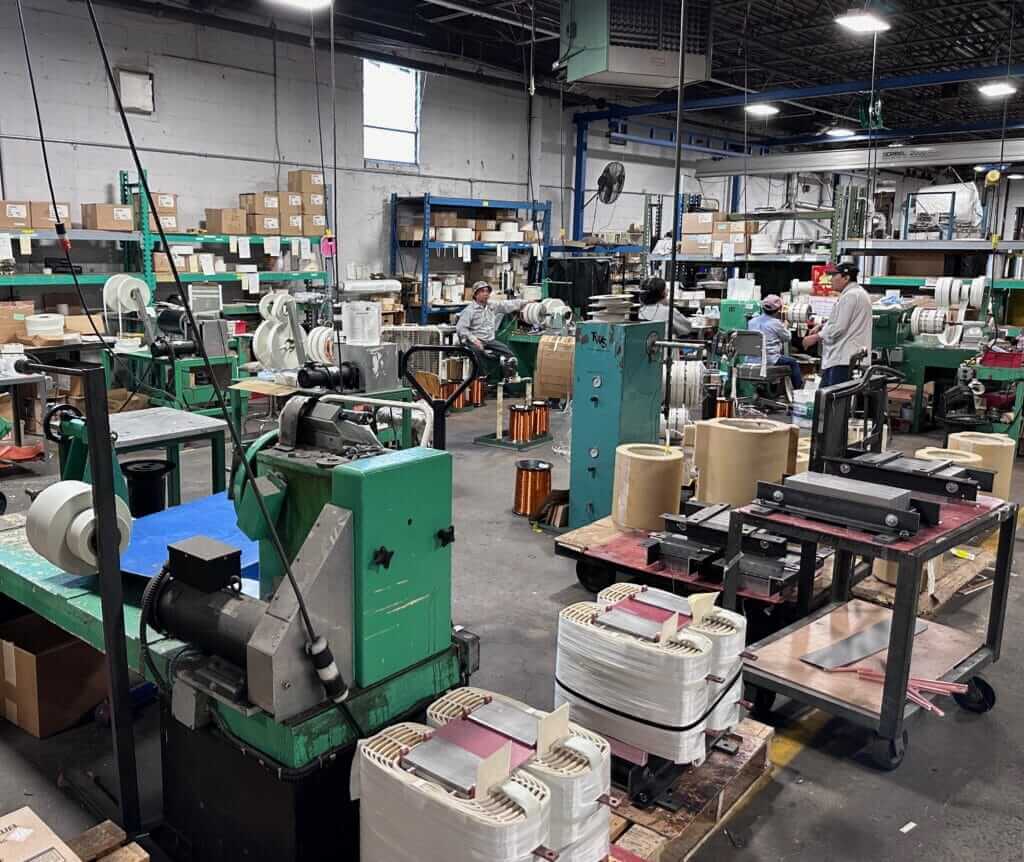
AFP Transformers Corp. manufactures a complete family of custom dry-type, cast coil, and epoxycast Harmonic Mitigation Transformers engineered directly at our Edison, New Jersey manufacturing facility. Built upon the legacy technologies of Field Transformer, IsoReg, and International Transformers Incorporated (ITI), our magnetics deliver unmatched durability and compliance.
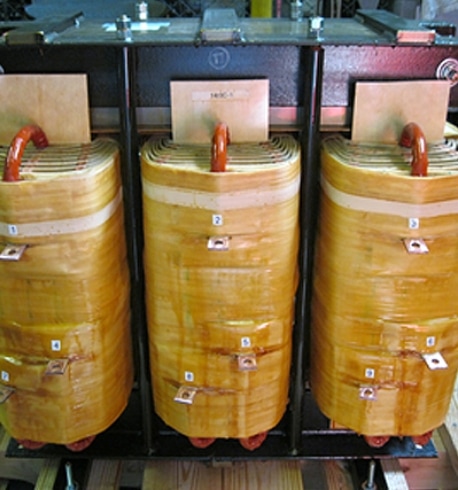
Series HMT-PS: Dual-Output Phase-Shifted Transformers
Designed for industrial automation and VFD drives, Series HMT-PS incorporates dual secondary outputs phase-shifted by 30° or 15° to neutralize 5th, 7th, 11th, and 13th harmonics.
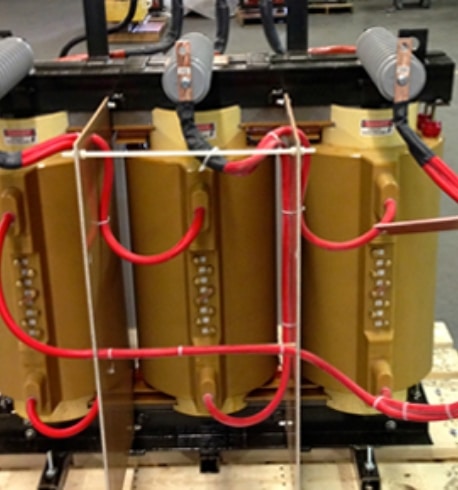
Series HMT-EC: Epoxycast & Encapsulated Harsh Environment HMTs
Engineered for mining, offshore oil rigs, chemical processing, and corrosive industrial plants. Vacuum-pressure impregnated (VPI) and epoxycast coils provide absolute resistance to moisture, dust, and conductive chemical vapors while mitigating severe non-linear load harmonics.
5. Future Procurement Trends: AI Data Centers, IEEE 519-2022 & Grid Modernization
As global procurement teams look ahead to 2025–2035, the demand for high-performance Harmonic Mitigation Transformers is accelerating due to three major macro industry shifts:
A. The AI & High-Density Data Center Explosion
Modern Artificial Intelligence clusters utilize high-density GPU server racks running intense computational workloads. These servers draw hundreds of kilowatts per rack through switch-mode power supplies operating at variable frequencies. The resulting harmonic distortion severely impacts upstream distribution transformers, causing localized core saturation, high audible acoustic noise, and extreme thermal spikes. Global data center operators are mandating phase-shifting HMTs at the PDU (Power Distribution Unit) level to isolate compute halls from the medium-voltage grid.
B. Stringent Utility Penalties under IEEE 519-2022 Mandates
Electric utilities worldwide are enforcing the updated IEEE Standard 519-2022 ("IEEE Standard General Practices and Requirements for Harmonic Control in Electric Power Systems"). Under these rules, commercial and industrial facility owners are penalized or subject to service disconnection if Total Harmonic Voltage Distortion ($THD_V$) exceeds 5% or Total Demand Distortion ($TDD$) exceeds specified limits at the Point of Common Coupling (PCC). Passive HMT units guarantee compliance without introducing high-frequency electrical switching noise associated with active electronic filters.
C. Decarbonization, Microgrids & Solar Inverter Injection
The integration of solar PV inverters, Battery Energy Storage Systems (BESS), and EV fast-charging stations introduces multi-directional non-linear currents into factory power networks. Custom HMTs act as bi-directional power quality buffers, isolating localized industrial microgrids from utility grid transient spikes and harmonic pollution.
6. Product Development & Next-Gen Manufacturing Innovations
AFP Transformers Corp. continues to pioneer advanced design and manufacturing techniques in specialty magnetics to maximize efficiency and minimize total lifecycle costs:
- Nanocrystalline & Amorphous Core Materials: By utilizing high-permeability, ultra-thin silicon steel laminations and amorphous ribbon alloys, AFP engineers have reduced core (no-load) hysteresis losses by up to 40% under high-frequency harmonic excitement.
- Low-Loss Transposed Strip Winding: To overcome severe skin effect and proximity effect losses caused by 11th, 13th, and higher harmonic current orders, secondary windings are constructed using transposed rectangular strip copper separated by high-grade Nomex insulation.
- Electrostatic Faraday Shielding: Every AFP HMT features a full-capacity copper electrostatic shield placed between the primary and secondary windings. Grounded electrostatically, this shield attenuates common-mode high-frequency noise spikes and transient voltage surges by up to 60 dB.
- Integrated Real-Time Thermal Sensing & IoT Monitoring: Optional embedded Fiber-Optic thermal sensors and RTDs monitor coil hot-spots in real-time, feeding predictive health data into factory SCADA and BMS systems.
7. Deep Technical Procurement FAQ (Frequently Asked Questions)
A K-Factor transformer does not eliminate or cancel harmonics; it is simply oversized and constructed with larger neutral conductors and sub-divided wound conductors to withstand the extra thermal stress caused by harmonic currents without overheating. In contrast, a Harmonic Mitigation Transformer (HMT) utilizes electromagnetic phase-shifting winding configurations (such as delta-wye or multi-phase offset secondary coils) to actively cancel specific harmonic current orders (e.g., 3rd, 5th, 7th, 9th, 11th, 13th) within its magnetic core before they flow upstream into the power grid.
Phase-shifting relies on vector addition of non-sinusoidal currents. A 30° phase shift between dual output channels shifts 5th and 7th harmonic current vectors by 180° relative to one another, causing them to destructively interfere and cancel at the primary bus. Similarly, a 15° phase shift targets the 11th and 13th harmonic pairs, while zero-sequence delta secondary windings trap triplen (3rd, 9th, 15th) harmonics within the local magnetic loop, preventing upstream voltage distortion.
AI data centers and modern industrial automation rely heavily on non-linear switched-mode power supplies (SMPS), high-density active rectifiers, and variable frequency drives (VFDs). These non-linear loads inject substantial harmonic currents into the electrical distribution system, leading to transformer overheating, high neutral current burnouts, nuisance breaker tripping, voltage waveform flat-topping, and premature equipment failure. HMTs eliminate these harmonics at the local distribution level, keeping Total Harmonic Voltage Distortion (THD-V) below strict IEEE 519-2022 thresholds.
While Active Harmonic Filters use power electronics and digital control loops that require ongoing maintenance, fan replacement, and software calibrations, an HMT is a passive electromagnetic device with no moving parts, semi-conductors, or control electronics. An HMT boasts a design operational life exceeding 30 years with minimal maintenance, zero high-frequency switching noise, lower standing losses, and significantly higher MTBF (Mean Time Between Failures), yielding a substantially lower total cost of ownership over its operating lifecycle.
Procurement engineers must verify UL Recognized and UL Listed certifications (UL 1561 for dry-type general purpose/power transformers), compliance with NEMA ST-20, IEEE 519-2022 standards for harmonic control, ANSI C57.12, and DOE 2016 efficiency mandates. Custom magnetics should also feature Class 220°C insulation systems with low temperature rises (e.g., 80°C or 115°C rise) for extreme operational thermal headroom.
8. AFP Transformers Enterprise Advantage: U.S. Manufacturing Excellence
AFP Transformers Corp. stands as a premier U.S. custom transformer manufacturer headquartered in Edison, New Jersey. Formed through the strategic acquisition of renowned magnetics industry pioneers—Field Transformer, IsoReg, and International Transformers Incorporated (ITI)—AFP brings over three decades of accumulated engineering knowledge to every application.
Our core enterprise capabilities empower procurement divisions to optimize their supply chain while maintaining uncompromising quality:
- Single-Source Procurement Consolidation: We supply dry-type power transformers, cast coil, epoxycast, heating furnace units, motor control reactors, and custom HMTs from a single vendor, drastically cutting vendor management overhead.
- Rapid Turnaround & Custom Engineering: Unlike standard off-the-shelf catalog distributors, our in-house engineering team designs magnetics to exact electrical, spatial, and thermal footprints, offering rapid prototype prototyping and accelerated production schedules.
- Volume Production & KanBan Stocking Programs: We partner with global original equipment manufacturers (OEMs) to offer JIT (Just-In-Time) inventory management and KanBan stocking programs, reducing client inventory holding costs while eliminating lead time bottlenecks.
- UL Recognized & UL Listed Certifications: Every transformer leaving our Edison facility undergoes rigorous factory acceptance testing (FAT) to ensure compliance with UL 1561, CSA, NEMA, and IEEE guidelines.
Optimize Your Facility's Power Quality Today
Consult directly with our Senior Engineering Team to analyze your harmonic load profile, select the optimal phase-shifting HMT configuration, or request a custom manufacturing bid.
Contact Us