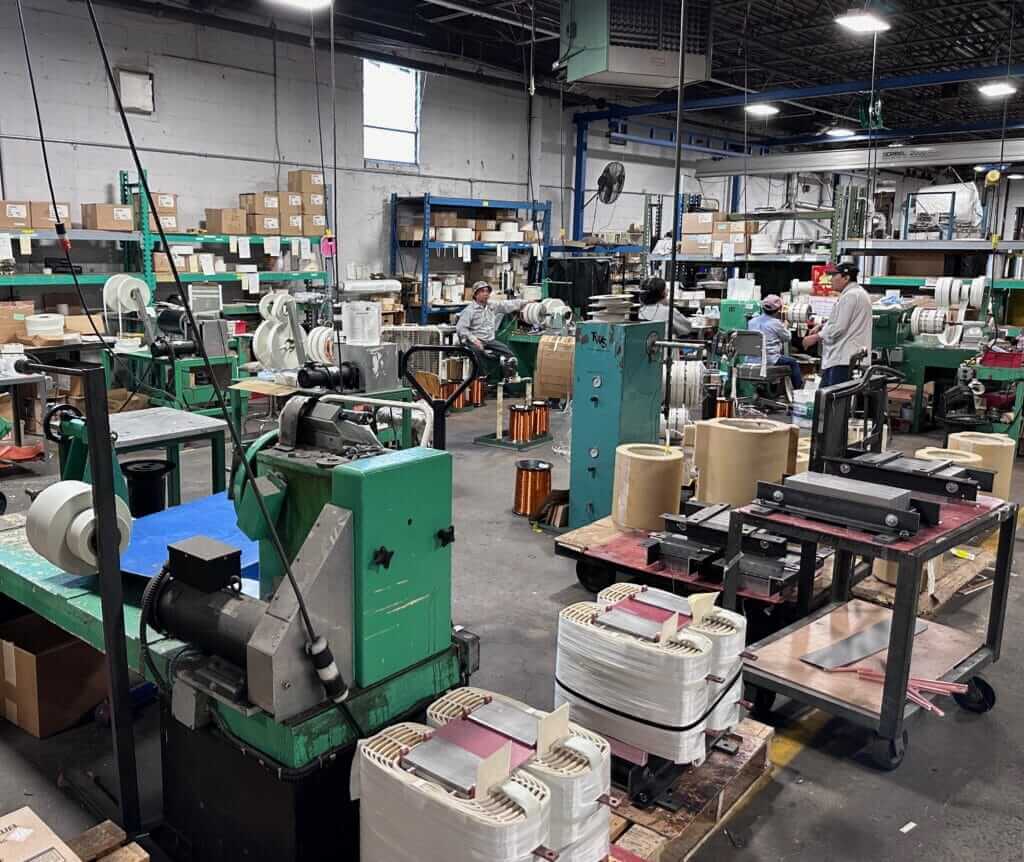
1. The Technical Blueprint of Custom Transformer Manufacturing
In high-demand industrial sectors, off-the-shelf power transformers routinely fail to meet the nuanced thermal, spatial, electrical, and environmental demands of modern power architectures. Custom Transformer Manufacturing is not merely an assembly process; it is a discipline of electrical engineering that balances electromagnetic physics, fluid thermodynamics, and material science to optimize core-to-coil coupling, minimize stray losses, and withstand non-linear electrical stress.
At AFP Transformers Corp., our custom manufacturing process starts with deep intent modeling. Whether an application requires stepping down medium-voltage utility distribution for a hyper-scale AI data center or managing aggressive transient currents in arc heating furnaces, transformer performance hinges on four core engineering pillars:
Magnetic Core Optimization
Utilizing high-permeability, cold-rolled grain-oriented (CRGO) silicon steel or amorphous metal alloys, precision step-lap mitered core joints reduce core loss (no-load loss) by up to 25% and minimize magnetizing current spikes during energization.
Winding Topology & Conductors
Custom winding configurations (disk, helical, foil, or concentric layer) tailored using high-grade oxygen-free copper or electrical-grade aluminum foil. Engineered specifically to mitigate skin effect and proximity effect losses under high-frequency harmonics.
Thermal Insulation Systems
Integration of UL-recognized Class H (180°C), Class N (200°C), and Class R (220°C) insulation barriers. Utilizing Nomex® hybrid insulation materials engineered to handle extreme thermal cycling without dielectric breakdown.
Short-Circuit Mechanical Strength
Custom structural clamping arrays and heavy-duty axial restraint hardware designed to withstand electrodynamic forces ($I^2R$ mechanical surge stress) during severe phase-to-ground or phase-to-phase fault events.
The engineering trade-off between core mass, winding resistance, and temperature rise is calculated using advanced finite element analysis (FEA). By accurately modeling flux leakage pathways and eddy current distributions prior to physical winding, custom manufacturing eliminates hot spots that lead to premature insulation aging, extending operational asset lifespans well beyond 30 years.
Core Material & Structural Design Trade-Off Matrix
| Design Parameter |
Standard Off-the-Shelf Transformer |
AFP Custom Engineered Transformer |
Impact on Industrial Procurement |
| Core Steel Grade |
Standard M-4 or M-6 Silicon Steel |
Laser-Scribed CRGO (M-2/M-3) or Amorphous Core |
Reduces lifetime operating costs via lower hysteresis loss |
| Harmonic Capability |
K-1 Rated (Linear Loads Only) |
Custom K-4, K-13, K-20, K-30 Rated Topologies |
Prevents overheating caused by VFDs, rectifiers, & AI servers |
| Enclosure & Ingress |
Standard NEMA 1 Indoor Only |
NEMA 3R, 4X Stainless Steel, or Cast Encapsulated |
Ensures zero downtime in corrosive, dusty, or outdoor environments |
| Footprint Flexibility |
Fixed Standard Dimensions |
Tailored Height, Width, & Busbar Orientations |
Eliminates costly structural bus duct modifications during retrofits |
2. Industrial Custom Transformer Product Portfolio
Selecting the ideal magnetics technology depends on atmospheric conditions, electrical load characteristics, and space constraints. Below is a detailed engineering analysis of custom transformer manufacturing solutions engineered at our Edison, New Jersey manufacturing facility:
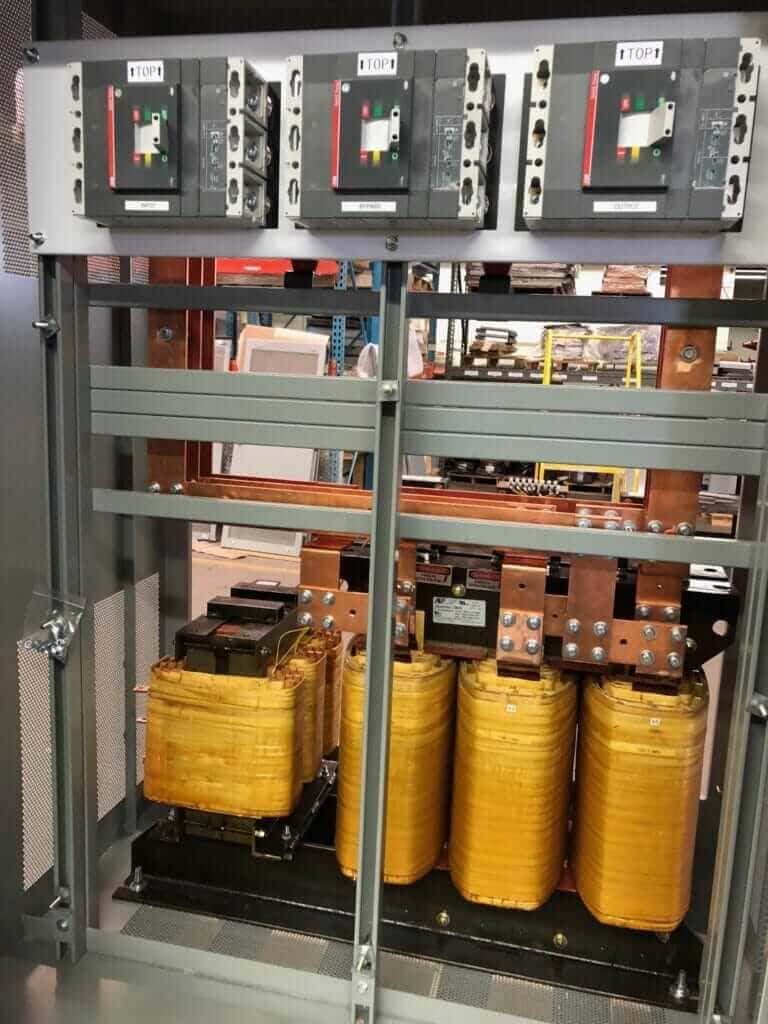
Specialty Magnetics & Custom Electrical Reactors
Custom Inductance
Tuned Filtering
High Frequency
Specialty magnetics represent the pinnacle of custom electromagnetic design. From single-phase air-core chokes to multi-winding interphase transformers, specialty magnetics regulate rapid $\Delta I / \Delta t$ current variations, suppress high-frequency line noise, and stabilize non-standard power distribution circuits. Designed to exact physical envelope requirements, these units integrate precision taps and copper foil coils to manage high ambient thermal conditions in military, aerospace, and medical power supply units.
Technical Details
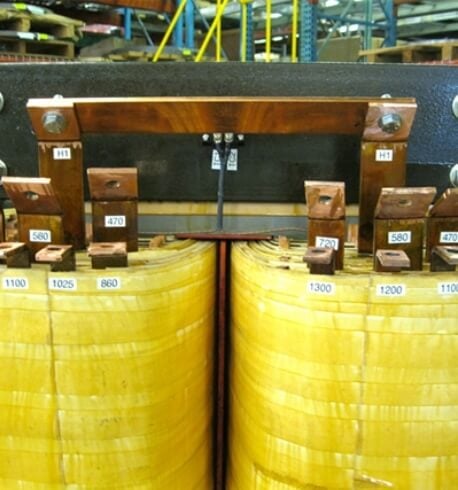
Industrial Dry-Type & Power Transformers
Up to 5 MVA
Medium Voltage
UL Listed
Engineered for safe indoor and outdoor primary power step-down applications without the flammability or environmental hazards of oil-filled units. AFP’s custom dry-type power transformers incorporate vacuum pressure impregnation (VPI) with high-temperature solventless epoxy resin, forming a moisture-proof seal over air-ventilated core/coil structures. Perfect for industrial manufacturing plants, commercial towers, and utility substations requiring multi-tap primary configurations.
Technical Details
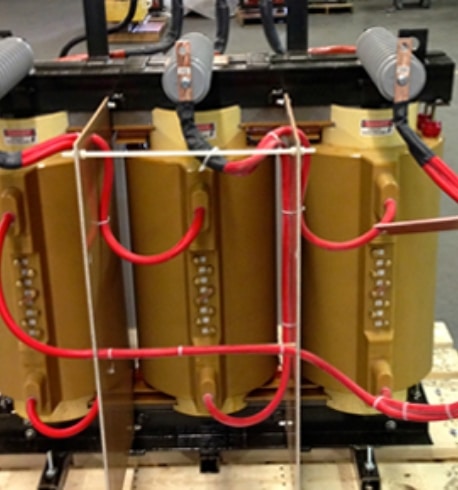
Epoxycast Coil & Castblock® Solid Resin Transformers
Zero Maintenance
IP54 / Marine Grade
Partial Discharge < 10pC
For hostile operating environments exposed to extreme dust, conductive moisture, corrosive salt spray, or chemical fumes, traditional open-wound dry-type transformers risk dielectric tracking and premature flashover. AFP’s Epoxycast Coil and Castblock® transformers vacuum-cast the primary and secondary windings in solid epoxy resin matrices. This solid casting completely eliminates air void pockets, delivering partial discharge levels below 10 pico-Coulombs (pC), exceptional short-circuit containment, and structural vibration resilience for marine, mining, and heavy chemical processing applications.
Technical Details
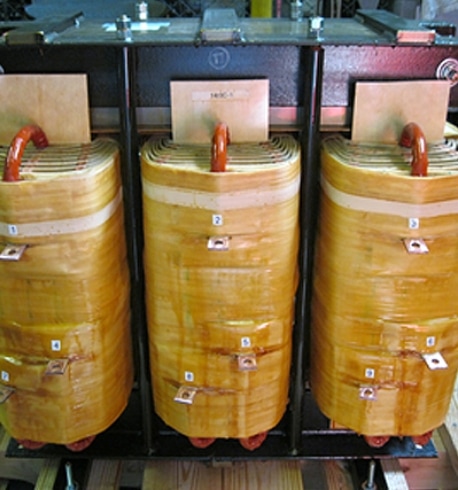
Harmonic Mitigation & K-Factor Transformers
Phase-Shift Cancellation
K-13 / K-20 Rated
Low THDi
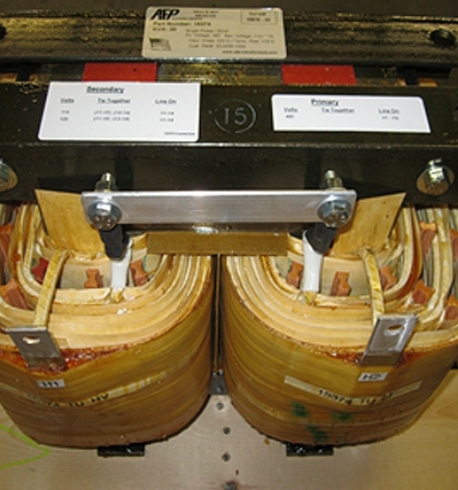
Modern industrial loads—including variable frequency drives (VFDs), uninterruptable power supplies (UPS), and switched-mode power supplies—draw non-sinusoidal currents rich in odd triplen harmonics (3rd, 9th, 15th). Left unmitigated, these harmonics cause excessive neutral conductor heating, transformer core saturation, and false breaker tripping. AFP custom manufactures phase-shifting harmonic canceling transformers (e.g., dual-output $\Delta$/$\Delta$-$\mathrm{Y}$ configurations introducing a 15° or 30° phase shift) that trap harmonic currents within the secondary windings, neutralizing Total Harmonic Distortion (THD) across the system distribution network.
Technical Details
High-Current Heating & Furnace Transformers
Heavy Busbar Output
High Amperage
Thermal Shock Tested
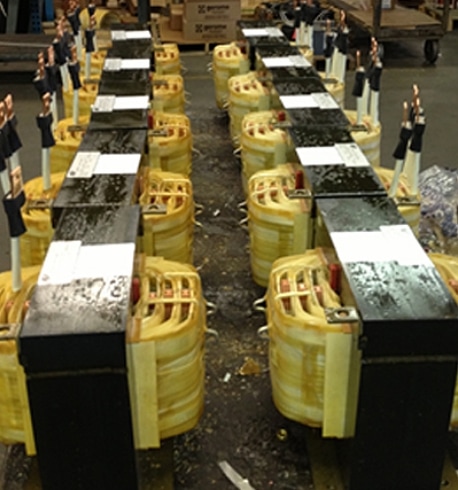
Electric arc furnaces, induction heating equipment, and glass melting operations require low output voltages coupled with massive continuous currents (ranging from several thousand up to tens of thousands of Amperes). AFP designs custom furnace transformers built with heavy-section water-cooled or forced-air copper busbar terminations. Reinforced core clamping prevents mechanical degradation caused by continuous magnetic forces during rapid load fluctuations.
Technical Details
Motor Control Transformers & Drive Isolation Magnetics
Low Inrush Current
VFD Galvanic Isolation
Compact Footprint
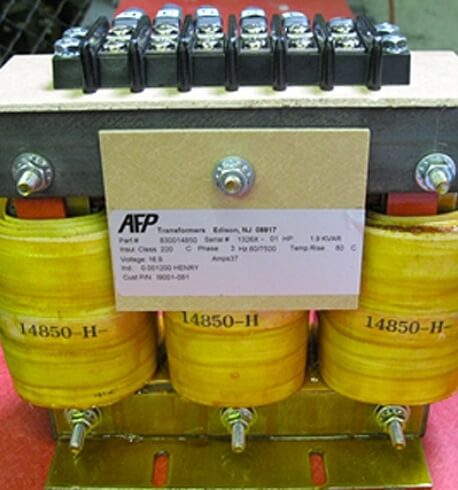
When electric motor starters energize magnetic contactors and relays, instantaneous inrush currents can spike up to 10 to 12 times steady-state levels. Standard transformers experience severe voltage regulation drops during inrush, causing contactor chatter or failure to latch. AFP’s custom motor control transformers are engineered with high thermal capacity and low internal impedance, maintaining secondary voltage regulation within strict 5% tolerances even during extreme inductive inrush surges.
Technical Details
Advanced Power Quality & Voltage Conditioning Equipment
Transient Surge Suppression
Voltage Regulation
Zero Ground Noise
Integrating constant voltage transformers (ferroresonant regulators), line isolation transformers, and active noise suppression magnetics, our power quality line protects sensitive industrial automation, computerized numerical control (CNC) equipment, and robotic manufacturing lines from voltage sags, surges, and common-mode electrical noise.
Technical Details
3. Strategic Industry Trends in Custom Transformer Manufacturing
The global electrification movement, accelerated by artificial intelligence, renewable grid integration, and industrial decarbonization, is placing unprecedented structural demand on power infrastructure. Procurement executives and electrical system designers must evaluate long-term strategic trends when specifying custom magnetics:
Trend A: AI Data Center Load Densities & Dynamic Transient Handling
Next-generation AI computation facilities utilize high-density server racks (exceeding 40kW to 100kW per rack) powered by liquid cooling systems and dynamic power distribution units (PDUs). These facilities generate rapidly fluctuating electrical loads and steep thermal gradient surges. Custom transformer manufacturing is evolving to incorporate micro-channel heat dissipation passages within transformer coils, alongside integrated fiber-optic temperature sensors for real-time thermal modeling. Custom K-factor transformers designed for AI facilities must guarantee ultra-low stray loss to maximize Power Usage Effectiveness (PUE) ratings.
Trend B: Smart Grid Decarbonization & Wide-Bandgap Semiconductor Integration
The wide-scale adoption of Silicon Carbide (SiC) and Gallium Nitride (GaN) power electronics in solid-state transformers (SSTs) and high-speed VFDs pushes switching frequencies into the tens of kilohertz (kHz). Traditional 60Hz transformer magnetic core materials experience high eddy current losses at elevated switching frequencies. Custom transformer designs now deploy hybrid cores combining high-frequency ferrite or nanocrystalline materials with ultra-thin amorphous ribbons to maintain electrical efficiency across wide frequency spectra.
Trend C: Nearshoring, Supply Chain Resiliency & JIT Production
Global supply chain disruptions over recent years underscored the operational risks of relying solely on extended overseas lead times for mission-critical electrical equipment. Forward-thinking procurement teams are pivoting toward U.S.-based custom transformer manufacturers offering agile engineering, rapid prototype iteration, and local stocking programs (such as KanBan and Just-In-Time delivery agreements). Local production removes multi-month ocean freight delays and guarantees direct engineering-to-engineering collaboration.
"Strategic procurement is no longer just about initial purchase price; it’s about Total Cost of Ownership (TCO), grid reliability, and rapid lead-time certainty. Partnering with a specialized domestic manufacturer turns custom magnetics from a supply chain bottleneck into a competitive operational asset."
5. Custom Transformer Manufacturing FAQ: Global Procurement & Engineering Solutions
Addressing key technical queries raised by global procurement managers, system integrators, and engineering consultants evaluating custom magnetic manufacturers:
Q1
How do I determine whether my application requires a custom-engineered transformer versus a standard catalog transformer?
Standard catalog transformers are designed for linear, non-critical commercial building loads with standard 60Hz utility voltages, standard 3-phase delta-wye connections, and normal ambient conditions. You require Custom Transformer Manufacturing if your application exhibits any of the following parameters:
- Non-standard input/output voltage combinations or high-frequency operating conditions (e.g., 400Hz aerospace or variable VFD frequencies).
- Significant non-linear harmonic loads requiring specific K-factor ratings (K-4 up to K-30) or phase-shifting harmonic cancellation.
- Constrained installation enclosures or unique physical dimensional footprints where standard enclosures will not fit.
- Severe operating environments involving high moisture, conductive dust, explosive vapors, or marine salt air requiring solid epoxy casting (Castblock®) or specialized NEMA 4X enclosures.
- Need for specialized winding taps, low-inrush characteristics, integrated temperature sensing (RTDs/thermistors), or dual-shielded electrostatic isolation.
Q2
What is the lifecycle Total Cost of Ownership (TCO) difference between copper and aluminum windings in custom dry-type transformers?
While aluminum windings offer lower initial capital expenditure (CapEx) due to lower raw material costs, copper windings deliver superior volumetric conductivity, smaller total physical transformer dimensions, lower electrical resistivity, and higher mechanical strength under severe short-circuit stresses.
From an operational expenditure (OpEx) standpoint, a custom-engineered copper-wound transformer engineered for low operating temperature rise (e.g., 80°C or 115°C rise over 40°C ambient) significantly reduces continuous $I^2R$ copper losses. Over a 20-to-30-year industrial operating horizon, the energy savings yielded by lower internal losses often far outweigh the initial material cost delta of copper.
Q3
How does solid epoxy resin casting (Cast Coil / Castblock®) protect against dielectric breakdown compared to Vacuum Pressure Impregnation (VPI)?
Vacuum Pressure Impregnation (VPI) applies a thin coat of protective varnish resin over dry-type open windings, penetrating surface gaps to protect against mild moisture and dust. However, air spaces remain between individual conductor turns.
In contrast, Epoxycast Coil and Castblock® manufacturing places the pre-wound coils inside a vacuum casting mold filled with liquid epoxy resin and silica fillers. As the resin cures under controlled temperature cycles, it forms a completely solid, monolithic dielectric barrier around the conductors. This eliminates internal air voids, preventing partial discharge ionization, offering total moisture impermeability (IP54/IP65 ratings), and providing superior mechanical clamping during high-surge fault conditions.
Q4
What technical information must an engineering team provide to request a custom transformer design proposal?
To accelerate custom transformer engineering and obtain an accurate technical proposal, provide the following core parameters:
- KVA / MVA Rating: Continuous capacity and short-term overload duty cycle requirements.
- Voltage Specifications: Primary input voltage, secondary output voltage, tap ranges (e.g., ±2.5% or ±5%), frequency (50Hz, 60Hz, 400Hz).
- Phase & Winding Connection: Single-phase, 3-phase, Delta, Wye, Zig-Zag, Scott-T, or multi-phase shifting outputs.
- Load Profile: Linear vs. non-linear, harmonic spectrum profile, K-factor requirement, motor inrush parameters.
- Thermal & Environment: Max ambient temperature, allowable temperature rise (80°C, 115°C, 150°C), altitude, NEMA/IP enclosure grade.
- Standards & Certifications: UL Listed/Recognized, IEEE C57.12, NEMA ST-20, CSA, CE, or RoHS compliance requirements.
Q5
How does AFP ensure exact fit-form-function replacement for legacy ITI (International Transformers Incorporated) or IsoReg units?
As the direct successor holding legacy technical archives for International Transformers Incorporated (ITI), IsoReg, and Field Transformer, AFP maintains comprehensive mechanical drawings, winding bills of materials, core lamination dies, and electrical test data for historical model lines. Our engineering department cross-references legacy part numbers to manufacture direct drop-in replacement transformers that align precisely with original mounting footprints, terminal busbar heights, and electrical performance curves.